

On 14 November 1955, King Bhumibol Adulyadej visited Thailand’s northeast during a severe drought. He noticed that the sky was full of cloud while not a drop of rain was falling. That observation was the beginning of the idea of making rain, which became Fon Luang, the Royal Rainmaking Project, a royally initiated program still flying missions today, more than seventy years later.
From idea to first trial took 14 years
The King pursued two directions: building weirs to store water, and finding a way to draw the water down out of the clouds. The second led to serious research into meteorology and weather modification technology, with M.R. Debriddhi Devakul, an expert in agricultural engineering, assigned to study techniques used in other countries, including Australia and Israel.
The first real trial took place on 1 July 1969 at Khao Yai National Park in Nakhon Ratchasima province. A light aircraft dropped dry ice over a cloud mass, and within just 15 minutes rain began to fall. That was the moment which proved an idea fourteen years in study could actually work.
The first rainmaking trial at Khao Yai in 1969 used an aircraft dropping dry ice over the clouds, and rain began falling within just 15 minutes.
The three steps still in use today
The technique that developed from there breaks into three main steps. The first is “triggering”, using salt and other compounds to stimulate cloud formation and attract moisture. The second is “feeding”, dropping calcium chloride to encourage the water droplets inside the cloud to merge and grow. The last is “attacking”, dropping a mixture of salt and urea to push a saturated cloud into releasing its rain.
In 1992 the project was formally raised to the Royal Rainmaking and Agricultural Aviation Bureau, under the Ministry of Agriculture and Cooperatives. More than 82 percent of Thailand’s agricultural land still depends primarily on rainfall, which keeps the program important for drought relief today, not only as a piece of history.
The conditions that keep rainmaking from working everywhere
The technique has come a long way since 1969, but it is not magic that produces rain from a clear sky. There has to be cloud already carrying a degree of moisture to work with. That is why rainmaking pilots survey cloud conditions before deciding to run an operation at all. If the sky is completely clear, no technique will produce rain. This is the limit most people misunderstand, assuming rainmaking can deliver rain in any situation.
The success of each mission therefore depends on reading conditions accurately: relative humidity, wind direction, and the height of the cloud base. Those change constantly, so every day’s operation has to be assessed afresh rather than following one fixed plan.
Why this matters to people who do not farm
Fon Luang is a clear demonstration that the clouds overhead are not passive things to wait on. They carry moisture and temperature conditions that decide whether they become rain at all. The same principle is what makes real-time cloud tracking useful for everyone, not just rainmaking pilots, because a cloud mass that looks like it is about to become rain can equally dissipate without producing any.
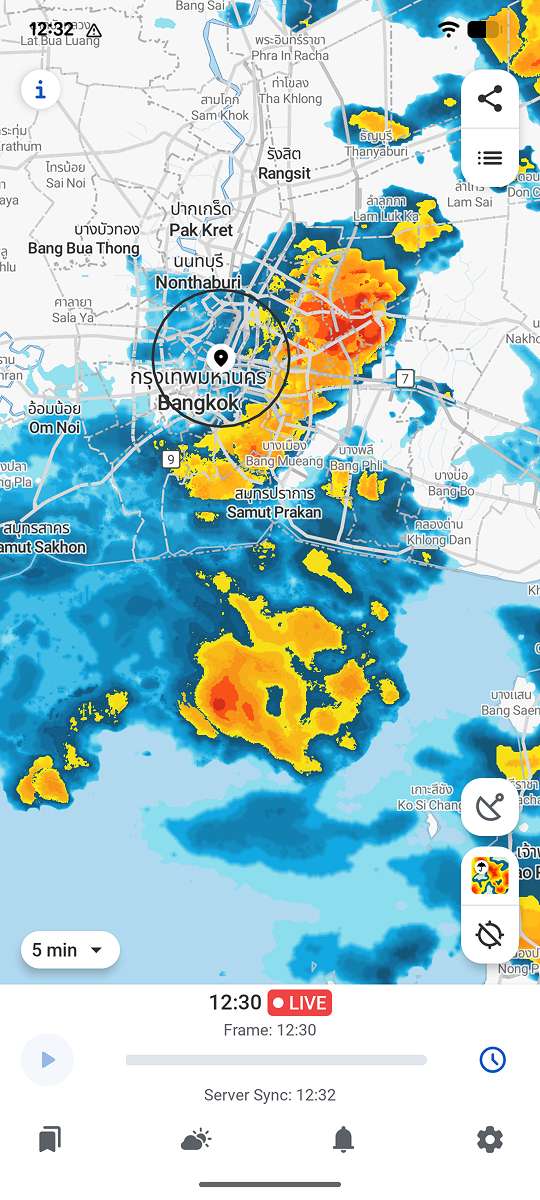
RainViewer shows historical radar, so you can see how a cloud mass formed and moved before it either turned into rain or faded without falling.
The technique keeps developing
The three basic steps have stayed the same, but the details of the compounds and the way they are dispersed have been refined continuously since 1992. Researchers at the bureau keep working to raise the success rate across more varied conditions, both in mountainous areas with complex airflow and on plains where moisture is often unevenly distributed.
Thai techniques have been shared with other countries on occasion, though they remain a formula developed specifically for tropical climate conditions, which may not work the same way in other climates with different humidity and temperature.
Track the rain the way a rainmaking pilot does
A rainmaking pilot has to pick the right cloud before dropping anything into it. That decision rests on understanding which cloud is developing toward rain. The same principle applies to anyone who wants to know whether the cloud overhead will actually deliver.


 RainViewer
