

A hot day is not a heat wave. The technical definition is more specific: a period of several consecutive days in which the temperature sits significantly above the historical average expected for that time of year and that region. A single unusually hot day can be ordinary variability. Persistence across days is what turns heat into a heat wave.
What actually defines a heat wave
The criterion is not a fixed absolute temperature such as “above 35°C” (95°F). It is a comparison against the local historical normal. Thirty degrees Celsius (86°F) in September in southern Brazil can constitute a severe heat wave, because it sits far above what the season should bring, while the same temperature in the Northeast, where it is common for much of the year, would be nothing out of the ordinary.
A heat wave is defined by temperatures persisting significantly above the local historical average for several consecutive days, not by a fixed absolute temperature value.
That relative definition explains why a heat wave in September, technically still winter or early spring across much of the country, draws so much attention. The contrast between the temperature recorded and what the season would normally bring is what makes the event notable, not the absolute reading on the thermometer.
Why the hot air insists on standing still
A heat wave is usually associated with a high-pressure system that stays stationary over a region for several days. That high-pressure system acts like a lid on the atmosphere: air descends, compresses and warms, while at the same time cloud and rain that would normally help cool the surface are prevented from forming.
It is that atmospheric block, not the season alone, that determines how long a heat wave lasts. As long as the high-pressure system stays in place, the heat wave continues. What usually ends it is the arrival of a cold front or a change in upper-level wind patterns that finally shifts the stationary system.
The part large cities play in the intensity
The urban heat island effect means large Brazilian cities feel a heat wave more intensely than the countryside nearby. Concrete and asphalt absorb heat through the day and release it slowly at night, keeping the temperature from falling far enough even after sunset. That lack of overnight cooling directly worsens the health impact, because the body has no time to recover before facing another day of extreme heat.
That pattern explains why large urban centres tend to record temperature records during a heat wave before the rural areas next door do, and why health authorities direct their warnings most urgently at those densely populated regions.
What the national average does not show
News coverage of a heat wave usually quotes record temperatures recorded in one or a handful of cities, which can give the impression that the event affects the entire country evenly. In practice a heat wave rarely covers all of Brazil at once, given the size of the territory and the climatic diversity between regions. One city can be setting a heat record while another, a few hundred kilometres away, stays within the normal range for the season.
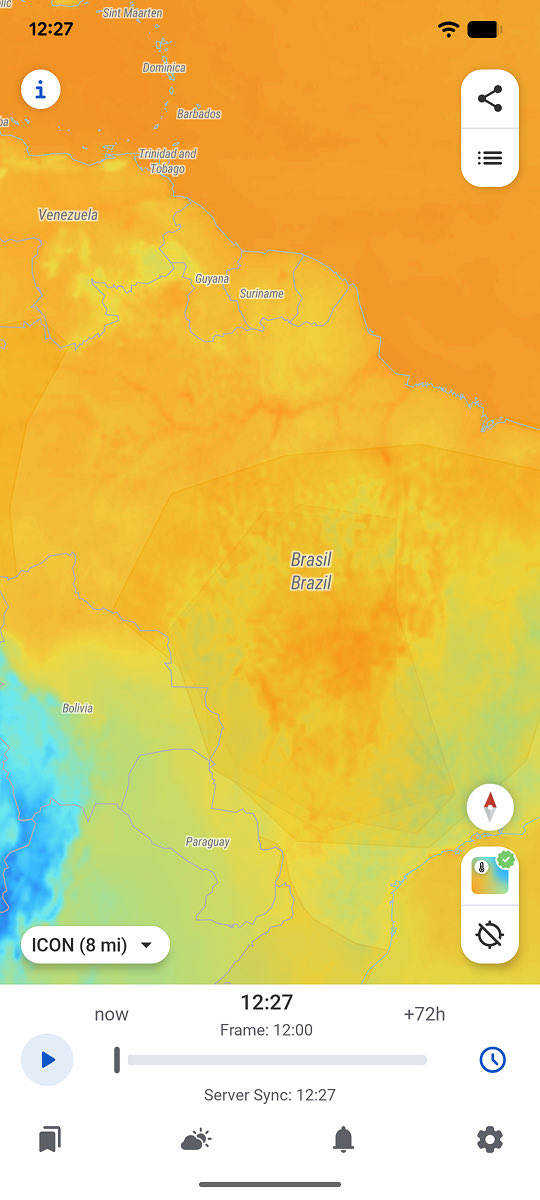
RainViewer combines live temperature data with precipitation radar, showing when a change is approaching that could end a heat wave at one specific location.
Follow when the change is actually coming
Knowing that Brazil as a whole is under a heat wave is less useful than knowing when it will end in one particular region. Because the event is held in place by a stationary high-pressure system, the end usually arrives visibly on radar, as a front of cloud and rain approaching from outside the affected area.
RainViewer shows the current temperature alongside live precipitation radar, which makes it possible to follow when that change is actually reaching one specific location, instead of relying on general forecasts for the whole country.



 RainViewer
