

The Southwest Monsoon doesn’t end on a single date across India. It withdraws gradually, starting in the northwest and retreating southeast over roughly six weeks, which means a large part of the country is technically still in monsoon season while another part has already moved into post-monsoon conditions.
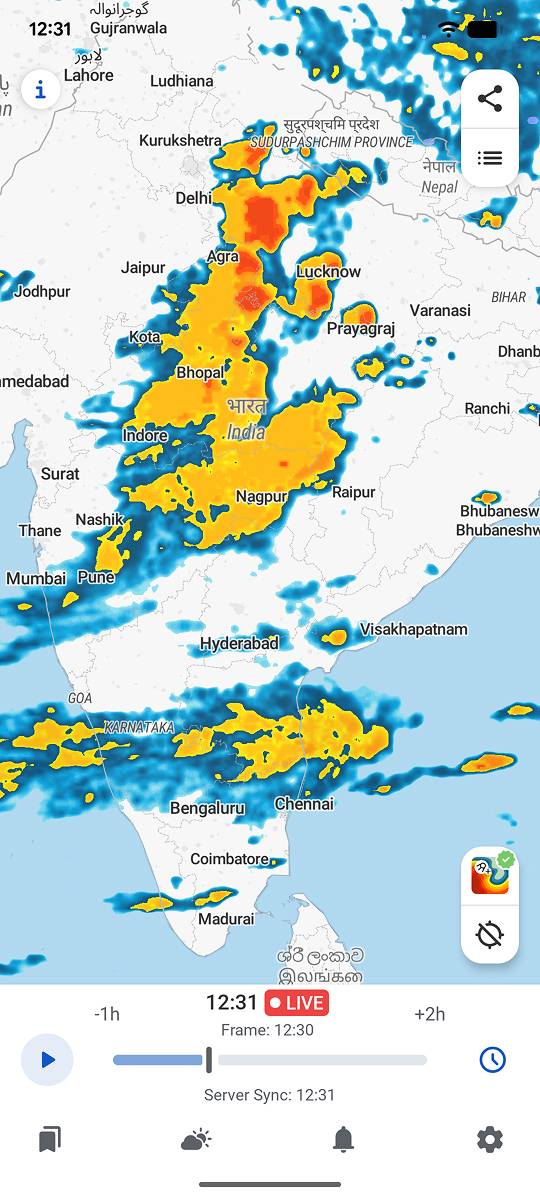
Withdrawal starts where the monsoon starts fading first
The retreat typically begins in northwest India, usually around Rajasthan, in early September, as the moisture-laden southwest flow that drives the monsoon begins to weaken there first. From that starting point, the withdrawal line moves progressively southeast across the country over the following weeks, reaching central India by late September and the southern peninsula, including Kerala and Tamil Nadu, only by mid-October in a typical year.
The Southwest Monsoon’s withdrawal begins in northwest India around early September and takes roughly six weeks to progress southeast across the entire country.
This staggered retreat means two regions of India can be in genuinely different seasons at the same calendar moment. Delhi might already be experiencing dry, post-monsoon conditions in mid-September while Kerala is still receiving regular monsoon rainfall, and both descriptions are accurate for their respective regions on the same day.
Why the monsoon can’t just switch off
The monsoon is driven by a large-scale pressure and wind pattern connected to the seasonal heating of the Indian subcontinent relative to the surrounding ocean. As autumn approaches and the landmass cools faster than the ocean, the pressure gradient that pulls moist southwest winds onto the subcontinent gradually weakens rather than collapsing all at once. That gradual weakening is exactly why the withdrawal takes weeks rather than happening overnight.
The India Meteorological Department declares withdrawal for a given region based on specific meteorological criteria, including a sustained period without significant rainfall and changes in wind pattern, not simply a fixed calendar date applied uniformly across the country.
Why withdrawal sometimes stalls or reverses briefly
The withdrawal line doesn’t always progress smoothly southeast on schedule. In some years, a temporary resurgence of moist southwest flow can briefly stall or even reverse the withdrawal in a specific region, bringing a burst of unexpected rainfall to an area that had already been declared in post-monsoon conditions. This happens when short-term atmospheric patterns, unrelated to the broader seasonal shift, temporarily override the general weakening trend that drives withdrawal.
These stalls are part of why the India Meteorological Department’s withdrawal declarations for a given region come with real meteorological criteria attached, rather than simply following a fixed date from the calendar. The underlying seasonal mechanism is reliable in its general direction, but its exact pace in any single year and any single region isn’t guaranteed to be smooth.
What “monsoon is retreating” doesn’t tell you locally
News of the monsoon retreating nationally is a useful general signal, but it says little about whether rainfall has actually declined in a specific location on a specific day. Because the withdrawal line moves through the country over six weeks, a location can remain firmly inside active monsoon conditions for weeks after the retreat has technically begun elsewhere in the country.
RainViewer tracks rainfall trends over weeks for a saved location, showing exactly when monsoon rainfall in that specific area actually starts declining, rather than relying on a national withdrawal announcement.
Track the retreat where you actually are
The retreating monsoon is a genuinely useful concept for understanding the broad seasonal shift across India, but it describes a six-week process moving across an enormous landmass, not a single event that happens everywhere at once. Knowing when the withdrawal actually reaches a specific location requires watching rainfall trends there directly.
RainViewer tracks rainfall trends over time for any saved location, making it possible to see the real decline in monsoon rainfall for a specific area as it happens, rather than relying on a national announcement that may not yet apply locally.



 RainViewer
