

A heat wave in Poland is no longer an exceptional event that turns up once every few years. It now arrives several times in a single summer, and the mechanism behind it is always the same: a high-pressure system that parks over an area for days and refuses to move.
How a blocking high forms
A high-pressure system makes air sink from the upper atmosphere, compressing and warming as it descends. The same system blocks cloud formation at the same time, removing the rain that would normally help cool the surface. As long as the high stays stationary over a region, the conditions hold, however long that takes.
A heat wave lasts exactly as long as the high-pressure system stays stationary over an area, blocking both cooler air and cloud formation.
That blocking mechanism is what explains why some heat waves last only a few days while others drag on for more than a week. It is not that the heat itself is unusually stubborn, it is that the atmospheric system producing it simply does not move.
What has actually changed in recent decades
The frequency and intensity of these blocking highs over Central Europe has risen in recent decades, a change many climatologists connect to a shifting jet stream, the band of strong upper-atmosphere winds that normally push weather systems along. When the jet stream weakens or bends further north, high-pressure systems have less momentum carrying them onward, and can stay in place considerably longer than they used to.
The role of cities in making it worse
The urban heat island effect means heat waves are felt far more intensely in large cities than in rural areas the same distance from the centre of the system. Concrete, asphalt and limited greenery make cities warm faster during the day and, more importantly, release the stored heat far more slowly at night. The result is that the centre of a large city can stay several degrees warmer than the surrounding area even after sunset, when natural cooling should already be under way.
That effect compounds with every additional day of a heat wave, because a night that does not bring enough cooling means the body has no time to recover before another day of exposure. It is exactly why prolonged urban heat waves are much harder on health than isolated hot days, even at the same peak temperature.
Why one number does not tell the whole story
Focusing only on the record maximum of a given heat wave misses an important part of the picture. Two heat waves with similar peak temperatures can have completely different impacts if one lasted three days and the other ten. It is the duration, which follows directly from how long the high stays blocked, that determines the real health and infrastructure burden of an episode.
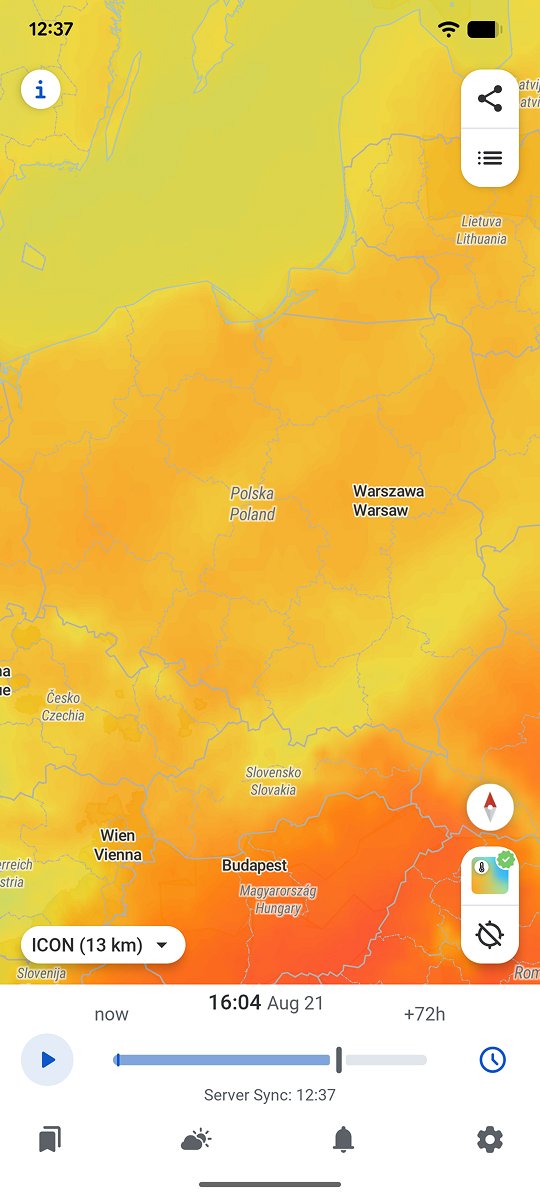
RainViewer keeps temperature history for saved locations, so you can compare the current heat wave against previous years, including how long earlier episodes lasted.
Follow the trend, not just a single day
The rising frequency of heat waves in Poland is not an impression, it is a measurable trend visible in the data of recent decades. Understanding that pattern changes how the next heat wave reads: not as an isolated event, but as part of a broader shift.
RainViewer keeps temperature history for saved locations, making it possible to compare a current heat wave directly against data from previous years.



 RainViewer
