Hurricane Tracker Charleston
The Storm Tracks layer shows current position, past path, forecast path, and the cone of probable tracks.


RainViewer shows storm tracks near Charleston on one live map.
The Storm Tracks layer shows current position, past path, forecast path, and the cone of probable tracks.
Current hurricanes near Charleston
This list names each active tropical storm or hurricane near Charleston, with its category and status. Each storm links to its own tracker page.
No active tropical storm or hurricane is listed near Charleston.
Last updated:
How RainViewer shows storms
The National Hurricane Center issues the official hurricane watches and warnings for Charleston. The Storm Tracks layer on the RainViewer map shows current position, past path, forecast path, and the cone of probable tracks. RainViewer does not replace official warnings.
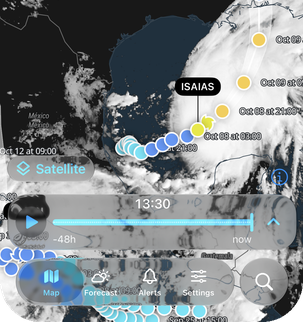
See the full storm path
Tap any point on the path to see wind speed, category, and direction at that point.
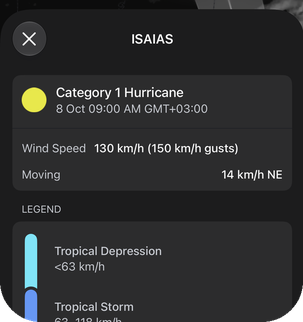
Read the category in one place
Open any storm to see its category and intensity.
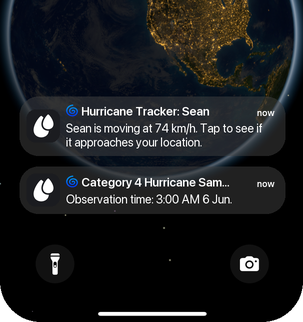
Get a notification when a storm approaches
RainViewer sends a Tropical Storm Alert when a storm approaches your area.


See Charleston storms in RainViewer
When is hurricane season in Charleston?
Hurricane season in Charleston runs from June 1 to November 30. Most activity falls between mid-August and mid-October, and September 10 is the climatological peak, according to the National Hurricane Center.
A hurricane starts as a cluster of thunderstorms over warm ocean water. Warm, moist air rises from the sea surface. The air pressure near the surface drops, and more air flows in. The rotation of the Earth makes this air spin, counterclockwise in the Northern Hemisphere. Weak winds high in the atmosphere let the system organize. A system with a closed circulation is called a tropical depression. It becomes a tropical storm when its winds strengthen, and the National Hurricane Center gives it a name. It becomes a hurricane when its winds reach hurricane strength.
Storms elsewhere in South Carolina
See current and past storms for the whole state on the South Carolina hurricane tracker page.
Hurricane categories, at a glance

Tropical Depression (<39 mph)
Rain and gusty wind, no hurricane classification yet.

Tropical Storm (39-73 mph)
Heavy rain, coastal flooding, downed branches.

Category 1 Hurricane (74-95 mph)
Roof and siding damage, downed trees, power outages.

Category 2 Hurricane (96-110 mph)
Major roof damage, trees snapped, extended power loss.

Category 3 Hurricane (111-129 mph)
Structural damage to homes, water and power loss for days.

Category 4 Hurricane (130-156 mph)
Severe structural damage, long-term power and water loss.

Category 5 Hurricane (157 mph or higher)
Total roof failure and wall collapse, area uninhabitable for weeks.
FAQ
Where can I see current hurricanes near Charleston?
The hurricane tracker map on this RainViewer page shows current storm tracks near Charleston, and the list under the map names each active storm near Charleston. When no storm is active, the list says so and links to storms in other regions. Past storms near Charleston are listed further down the page.
When is hurricane season in Charleston, and which months are busiest?
Hurricane season in Charleston runs from June 1 to November 30, and most activity falls between mid-August and mid-October, according to the National Hurricane Center. September 10 is the climatological peak, the date when historical records show the most tropical storms and hurricanes.
Which official source issues hurricane warnings for Charleston?
The National Hurricane Center (NHC) issues the official hurricane watches and warnings for Charleston, and publishes advisories for every active Atlantic storm. RainViewer shows storm tracks on a map and does not replace official warnings. The NHC is the source for official storm forecasts.
What does the forecast cone show on the Charleston map?
The forecast cone on the RainViewer map shows the probable track of the center of a storm during the forecast period. The cone does not show how far wind, rain, or storm surge reach from the center, so areas outside the cone can still have storm effects. The cone is part of the Storm Tracks layer, together with the current position, the past path, and the forecast path.
Where can I see rain radar for Charleston?
RainViewer shows rain radar for Charleston, and the Charleston weather radar page lists radar coverage and links to city radar pages. RainViewer updates radar every 5 minutes. Radar shows rain inside a storm. The Storm Tracks layer shows where the storm is moving.
 RainViewer

